
Are you unsure about how long a feeding bag should be used when preparing enteral nutrition support? We understand that, whether you are a professional healthcare provider or a home caregiver, this seemingly simple question of timing carries profound concern for the patient's safety. At Greatcare, we consider product safety a lifeline, and clearly defining and adhering to the single-use limit of feeding bags is a crucial safeguard.
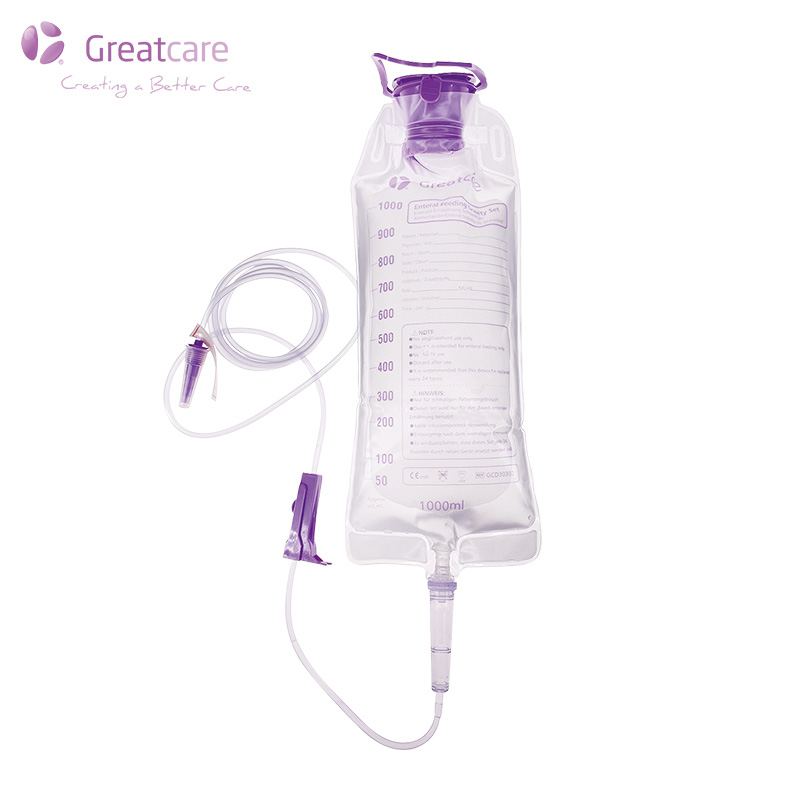
Enteral Nutrition Feeding Bag
How long should a feeding bag be used at a time?
The answer is clear and strict: a complete feeding bag system should not be used continuously for more than 24 hours.
This is not a casual recommendation but a gold standard based on international clinical practices and infection control principles. The reasons are:
Bacterial growth window: Nutrient solutions are ideal media for bacterial growth. At room temperature, microbes proliferate exponentially in the tubing and bag. Beyond 24 hours, the risk of contamination rises sharply, potentially causing diarrhea, fever, gastrointestinal infections, or even systemic infections.
Nutrient stability: Some nutrients (such as certain vitamins and fats) may degrade or change chemically when exposed to the environment for extended periods.
Changes in material integrity: Prolonged contact with nutrient solutions may subtly alter the physical and chemical properties of the bag and tubing, affecting their safety and functionality.
A critical rule to follow is this: "24 hours" is counted from the initial filling of the nutrient solution. Regardless of whether infusion is continuous or intermittent, or if the bag is refrigerated, it must be discarded and the system replaced after 24 hours. Never extend the usage time just because "it’s not finished yet."
How is the feeding bag connected to the patient?
The feeding bag is a closed, sterile delivery system designed to ensure the safe and accurate transfer of nutrient solution from the container to the patient.
Detailed explanation of connection path and safety design:
System starting point: the feeding bag itself
The bag body is made of medical-grade materials with a clear capacity scale.
There is a dosing port and a hanging hole at the top, and a slender infusion line is connected to the bottom, and the end of the pipeline is a connecting joint.
Key connection point: confluence with feeding tube
The end of the infusion line is connected to the outside port of the nasogastric, nasoenteral, or gastrostomy tube placed in the patient by a sterile connector.
"Locking" is the key: The joint must be fully locked by rotation, forming a closed channel to prevent nutrient solution leakage or bacterial intrusion.
Control hub for flow rate:
The tubing is equipped with a flow regulator that controls the drop rate by sliding or rollers.
The tubing often contains a drip hopper to observe whether the infusion is smooth.
How do you establish a safe 24-hour replacement process?
Incorporate 24-hour replacement into your daily care routine to make it a habit without thinking:
Clear timing starting point: Clearly write down the date and time of the first filling on the bag label (e.g., 05/25, 08:00).
Set double reminders: Use your phone's alarm clock and physical prompts (such as sticky notes on the refrigerator) to remind you to change them around 23 hours.
Perform standard operations:
Preparation: Wash your hands and prepare your new feeding bag.
Orderly replacement: Turn off the old line regulator, unlock the old fitting, quickly connect and lock the new line, and then turn on the new regulator to start infusion.
Dispose of it properly: Dispose of the old system properly as medical waste.
Record and observe: Register the replacement time in the care log and observe whether the patient feels unwell after using the new system.
Why is adherence to the 24-hour norm an unnegotiable bottom line of safety?
Imagine the feeding system as the "life supply line" of the human body. Once this line is contaminated with bacteria, it becomes an "infection channel" that leads directly to the internal organs. Adhering to the 24-hour replacement guideline is to use known and controllable costs (replacement of a set of pipes) to prevent unknown and serious risks (nosocomial infection, sepsis).
This is not only an operating norm, but also a manifestation of preventive medical thinking. By choosing a brand like Greatcare that incorporates safety timelines into product design, you are choosing a proactive, reliable security partner that helps you meticulously implement this critical safety guideline through clear design and reliable performance.
We firmly believe that the most professional care is reflected in the strict implementation of every detail standard. Greatcare is committed to providing you with products and knowledge that are not only safe and reliable, but also empowering precision care. If you have more questions about any aspect of enteral nutrition support, or would like to learn more about how we can help you easily comply with safety regulations through product design, please feel free to contact us. Our team is ready to support you with professionalism and sincerity.


